When Dr. Kizza Besigye’s convoy made a halt at Ogooma primary school in Kumi district yesterday, one could have been forgiven to think that his second rally of the day would be under one of the umbrella shaped mango trees in the school compound.
However, his car, with a crowd in pursuit, branched off to a narrow village path, into maize gardens and finally stopped in the middle of a potato garden facing a giant termite mound.
Its innocuous look notwithstanding, the giant termite mound is a mass grave containing the remains of close to 200 people killed at the height of the insurgency in Teso sub region in the early 1990s.
In the late 1980s and early 1990s, Teso was a battle ground between government soldiers and a rebel group allegedly led by Peter Otai – a former minister in Dr. Milton Obote’s second government (1981 -1985).
According to peter Odikore, a 76 year old resident of Ogooma parish, the mass grave was initially a village well which was turned into a mass grave.
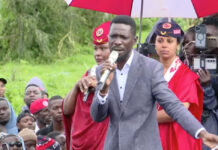
Besigye’s rallies are normally raucous, but the one at the mass was verily surreal – initially devoid of the sloganeering that precedes his addresses.
“We must be courageous enough to face and interrogate our dark past. There are many demons lurking everywhere and we cannot pretend to be progressing when the hearts of victims of Uganda’s dark past are bleeding. Hospitals, schools and good roads are not enough,” FDC president and former army chief, Gen. Mugisha Muntu broke the silence.
Besigye picked a leaf from Muntu’s book, promising not to draw a veil over dark episodes in Uganda’s turbulent past.
“We must inquire into all dark episodes and find out what exactly happened and who was responsible. We cannot sweep these things under the carpet and pretend to be moving on as a country,” a somber Besigye said.
“We will compensate all the relatives of these crimes,” Besigye said after receiving a list of the names of people interred in the mass grave.
While campaigning in Acholi sub region – one of the regions that bore the brunt of a protracted insurgency – Besigye, last month promised to institute a truth and reconciliation commission akin to the one put up in South Africa to deal with the excesses of the Apartheid era.
Dr. Olara Otunnu, a former UN diplomat and one time UPC president, has too called for a truth telling commission to help Uganda exorcise demons of its turbulent past.
However, there are concerns among a section of Ugandans that a truth telling commission will simply scratch scars of a healing wound, rather than help Uganda close a dark chapter.
During celebrations in January last year to mark 29 years since the ruling NRM came to power, President Yoweri Museveni, conceded that some rogue elements within the then national army – National Resistance Army – committed heinous crimes against civilians during efforts to pacify Teso and Acholi.
Museveni, however, did not explicitly promise to set up a truth telling commission.Earlier, Besigye visited a broken bridge separating the two sub counties of Nyero and Mukongoro. The bridge over Okokoro swamp, according to locals, caved in a decade ago.
Efforts to replace it some six years ago proving fruitless after the bridge under construction collapsed before completion.
“We will fix bridges like this one. These are issues that affect the lives of our people,” Besigye said, as a number of people waded the shallow waters to come and listen to him.
During the rainy season, the seemingly small bubbling brook swells into a raging river, making it hard to cross on foot.
At Atutur Sub County and old Malera in Bukedea district, Besigye who had MPs Amuriat Oboi and Geoffrey Ekanya in tow said the worst mistake his supporters can make at this time is to get intimidated by police and government functionaries.
“Do not get intimidated by police and crime preventers. I know they will come here but stand firm, this is our country,” Besigye said. Besigye will hold rallies in Budaka today after concluding his campaign presidential campaign in Teso.