Thank you for being part of us this memorable evening. We promise to continue to bring you more election events as they unfold.
Good night
12:50am: Debate ends
National anthems being sang. First the East African anthem and later, the Uganda National athem
12:40am: Justice Ogoola takes to the podium, moves a vote of thanks.
Thank you to the candidates; who will ever forget Kyalya walking along the aisle with Museveni and getting snatched by Mbabazi. Who will not remember Baryamureeba, deeply immersed in Deutronony? Who will not remember candidates holding hands and praying..
Thanks to the moderators, MCS, media and all other people, the audience, including election observers.
Thank you all who are at home, listening to this conversations.
12:30am: Closing statement
Kyalya: as we get to the elections, all of us have gone past Feb 18. Come out, make your choice and we move on without any violence.
Mabirizi: I want to ask all Ugandans to trust me with their votes. I am the youngest candidate here. Vote me so that we can have new ideas. My symbol is a ball and I will work with all these candidates here. Engineers are not talkers. I am a man of action.
Besigye: the country is worried and they should be. We have never had a peaceful handover of power. I am surprised that Museveni is saying that people should be allowed to choose when he went to the bush in 1980. Now we know the election is not free and fair and every one should be worried. Everybody should come in with the crime preventers and statements coming in. I am sure that we shall have change.
Biraaro: I have two requests; that the people of Uganda vote a government that will unite all Ugandans. I request all to join me in the fast and we pray to God so that at least through the fear of the Lord, we may see something good out of these elections.
Baryamureeba: the message is that Joshua had to be raised in the Bible and we need to get a new leader to invest in the people. I will be able to produce a billionaire every year.
Mbabazi: Magufuli of Tanzania has been minister and the day he was sworn in is the day Tanzania began to change. I appeal to Ugandans, it is time to change.
Bwanika: the people should elect the president that they deserve. Whether we have violence or no violence is in the hands of Badru Kiggundu and he should ensure peaceful elections.
Museveni: The Bible says that they shall know them by their fruits. Everybody knows who has made Uganda recover. Whoever does not see where we came from I doubt that they will manage.
There will be peaceful elections in Uganda. Nobody will disturb our peace. Nobody will threaten us. Why do you threaten our people. We shall not allow this to happen.
12:26am: Two questions from public
Mbabazi: Why did it take you 30 years to realize there was a problem?
It did not take me 30 years, but I hoped there were steps we would take to rectify some problems. I was also abound by the factors in public life and service.
Museveni: If you lead the country for 30 years and you still think nobody else can, is it not failed presidency?
Those are some of the recycled bad ideas. Look at Israel, they have used all their leaders, the young and old. I cannot understand the obsession that the old cadres should not be there for leadership. After all, it is the people who vote and if they say we no longer want you, I go.
We have old people and young ones. What is the problem if you make all these leaders available and allow the people to select. If people select Kyalya, good, if they select the old man, there is no problem. It is not that I am the only one with the wisdom and knowledge. I think it is a wrong argument.
Moderators ask questions
12:20am: Most important decision AND worst regrettable decision
Bwanika: I have to think through. It is when I gave up my job to come and volunteer to serve in church
Regrettable: None.
Mbabazi: My decision to fight for justice, democracy and the welfare of our people.
Regrettable: Not to leave up to my known practice of resisting dictatorship whenever it showed its face.
Baryamureeba: I was offered several jobs and I decided to come back to Uganda.
Regrettable: I had capacity to employ many people , but I did not
Biraaro: People came to bribe me with ivory and I took that ivory to bank of Uganda
Regrettable: I neglected my health and now I have ulcers
Besigye: Leaving my job in Nairobi and head for the tall grass in Luwero to fight.
Regrettable: continuing to fight and bringing my family into danger. it was not intended.
Mabirizi: I paid my school fees after my father died
Regrettable: my mock elections. People turned out many and I have not released the results.
Kyalya: When I decided to ask Museveni to work in Busoga under poverty alleviation.
Regrettable: I was self-centred and I left my people with the MP who was not qualified.
Museveni: When I decided to put my university choice to the University of Dar es Salaam
Regrettable: I delayed to shoot AMIN SOLDIERS AND we lost our colleagues in Mbale.
12:00am: Gender
Mabirizi: all institutions have to be represented at every level. We want to encourage people to love living in villages. We want to ensure there is water and electricity, infrastructure, etc.
Museveni: the women in agriculture are part of the family unit, but since agriculture is linked with land, it is better it is regarded as one unit. There is the traditional way of life like the Karimojong.
The first challenge has been to convert them from traditional to commercial agriculture. In west NILE, THEY GROW TOBACCO, but it is not profitable on a small scale. We have addressed seedlings, value addition, dertilisers, etc. we have set up the women fund which they can access directly.
11:50PM: Unemployment
Kyalya: We have got the western way of thinking, but we have forgotten the land that we have can be a source of money. There are opportunities that the youth can use. There has been a worry that Museveni will not hand over power and will be my advisor when I am president of Uganda. And I will also be available to serve the country after elections.
Besigye: we must have relevant and quality education for our people. That is why we are talking about vocationalising education so that students learn carpentry while in school. We would like to introduce the system so that our young people have the skills for the opportunities in the economy. We are also looking at the process of reorientation after school, where the youth are taken to institutions that manage that transition after formal education. We shall have industrialization led by government and citizens having shares.
Mbabazi: it requires a very close look at the type of education we give to our children. If our children cannot find job in Uganda, how can we expect that they will find jobs elsewhere? I will want to provide skills that are demanded internationally. My campaign is about change from one generation to another. Me and Museveni are of different age and this transition is very critical. We need to give our children the necessary knowledge and skills.
11: 40PM Oil: NRM discovered oil – Museveni
Besigye: I believe he knows oil was known in that region before independence. It was not the NRM who pointed that out, but the investors. Would he not confirm that Parliament made e=resolutions regarding oil and they were taken to Kyankwanzi and when they came back, they had changed positions?
Kyalya: I am feeling like a referee and before I came here, I was assured we are moving forward. Not just talking about the past.
Museveni: what Besigye said is not correct. The British looked for oil and in 1956, they wrote a report that there was no oil in Uganda. On caucus, we do it because it is part of our political parties.
11:35PM: Climate change
Biraaro: Climate change will affect us much more than it will affect other developed countries. We must have capacity for irrigation, storage, etc. so that our people are not exposed to extremes of climate change. We should have afforestation in every district. It is a survival issue. That is why I will devote sh30b per district. We are exposing our people to the vagaries of climate change. I will be creating military units that can help rescue people in cases where there are floods and landslides.
Mabirizi: My government will invest more money in agriculture and tourism. When we talk about oil. Oil is good but dangerous to our environment.
11:30PM: Voting in diaspora
Mbabazi: I will allow Ugandans abroad to vote. I told them two years ago and I will allow them to vote. Can you imagine their children are treated as foreigners when they come here?
Bwanika: we should allow them to vote and contest except contesting for presidency.
11:25PM: BACK FROM THE BREAK
11:12PM: BREAK
Debate goes for a technical break. Candidate Museveni is seen chatting with candidate Kyala.
11:00PM: International trade
Mbabazi: we are ell endowed, with a wonderful climate and what we are planning to do is to encourage production. We have suggested that in order to attract investment, we should add value and that is why we are proposing to reduce power tariffs so that we raise our production. I will create a ministry in charge of creating market for Ugandan products.
Mabirizi: Ask yourselves, why do you allow investors to come here and borrow money. You can’t have good investment and trade where there are high taxes. There is need to reduce the taxes so that the environment is favourable.
Bwanika: I am complaining that the frequency of asked Bwanika has reduced. I should be allowed to comment on the integration and trade. I want to overhaul the entire foreign policy of Uganda. I want to focus on trade. Energy is not about reducing tariffs, it is also about availability of power. We must build dams and cheaply so that power is available.
About Ugandans in the diaspora; we don’t know where they are and what they do because they send a lot of money into the economy. I will appoint a minister in charge of the people in the diaspora.
Kenyans have property here and we have nothing here. They will outcompete us. Then whoever wants to invest here looks at the size of your economy.
Kyalya: we have said that Swahili is the ideal language, but we are not doing enough to teach people the language. We need to commercialize agriculture. We need to promote investment. We should not allow foreigners to own land here. In the UK, you don’t own land or buy a house.
How can we export what we don’t own. It is the Indians who are growing matooke, cotton and the rest of Ugandans are just slaves. People don’t get value out of what they grow or produce.
Besigye: Our country has been open not to foreign investors, but to fake investors. You have national assets turned upside down under the guise of investment. A case in point is the Coffee Marketing Board assets, Shimoni schools wheich were destroyed and no investment was done. The climate is not favourable. If we have threats of the government. You have teargas all over and you don’t expect investors to come. If you have a system that is corrupt, no investor would want to come and invest here. We need to put our house in order. We must encourage Ugandans to invest by making credit readily and affordable.
Museveni: When I listen to the talks here, it confirms one point. That there is one person here who can manage Uganda. All these people want ready made things. They don’t seem to have an idea on how to start small and build. You know I have led that process of starting small and build. And that is why there is a disconnection between me and some of the people we were working with. Tax collection has gone up because of investments. These Indians you are talking about are entrepreneurs. In 1958, there were only three Ugandans who were selling threads and the rest were Indians. But now that has changed. What we should do is to exploit everything.
Meanwhile, candidate Museveni keeps smiling each time candidate Mabirizi is answering questions
10:35PM: About EAC:
Museveni: The issue about integration is about prosperity and security. We are consuming only 1,000,000 tons of maize , yet we produce 4,000,000 tonnes. If we do not sell to KENYA AND Sudan, we would have nowhere to sell the rest. The federation is prosperity of our people are security.
The Americans are talking about 4 dimensional superiority; on land, sea, space and air. How are we different from the tribal chiefs who could not defend their chiefdoms if we do not have systems to defend our nations. Who can guarantee our security?
It is now about the speed, not the principle.
Mabirizi: we cannot have EA federation unless we adopt what other countries are doing. We should have term limits. Others have and here we don’t have them. Some Tanzanians are saying we are planning to grab their land. We should revisit our agreements and constitutions.
Besigye: The question of integration has issues because it is talked about by leaders, not the people themselves. We are talking about integration when we have no language that unites us. We must make sure there is integration of our institutions or developing people to people relations. We should have integration of people not the governments or leaders.
10:30PM: Ugandans suffering in Arab countries:
Kyalya: Being a daughter of an ambassador, I understand this very well. The missions are not doing much and they have to wait for Kampala to decide. Girls and women are suffering and they have not been helped.
Baryamureeba: I will deal with the capacity. Most of our ambassadors are political failures and they lack the capacity in terms of qualifications. But there is also lack of facilitation. We should look at how we deal with these countries. When I am president, I will ensure that the embassy is fully facilitated to deal with all issues that arise.
10:25PM Citizenship: Are Ugandans citizens or subjects?
Bwanika: Tthere many people from the neigbouring countries who are going to vote and determine the destiny of Uganda. People from Rwanda, Congo, South Sudan, Tanzania are going to vote. These are serious issues we must address. We need to define who is a citizen of this nation otherwise the privileges of the Ugandans are not going to be there. Being a Rwandan, Congolese and Ugandan at the same time is not propr. We need to subject this to the entire population.
Biraaro: democracy must address the issue of being oppressed. I went to the border with Kenya and realized that some of the Kenyans got our IDs, that one should be sorted. There should not be any oppression by the government.
10:20PM: DR Congo issue: Besigye and Museveni clash
Uganda owes DRC over $10b:
Besigye: I had earlier made a comment about that debt. It came as a result of reckless behavior of our government. We shall look for a way of negotiating with Congo and we need to avoid similar situations.
Museveni: I reject what Besigye is saying because it is false. We intervened in Congo because we had concerns. There were groups fighting us; NALU, ADF and we could not accept and Besigye can go to that area and campaign the way he wants. I don’t know why they did not win the case. I wanted to go there as a witness and they refused. The bottom line is that nobody will play around with the peace of Ugandans when I am still president.
Besigye: I recognize the role and duty of the leader of the country to defend the country. I was saying it must be done according to the laws of the country. It does not matter how offended the president is. When it happened, I was a member of the organs that should have done approval and it was never discussed at all. It is not excusable and that is the point I was making.
Mbabazi: I represented the country in the Internatioanl court of justice and the decision was not based on the legality, but on the plunder of Congo resources.
10:15PM: War over River Nile:
Mabirizi: When I come into power, there will be no war over that. The reason why countries are failing is because there are no institutions working with institutions of other countries.
Mbabazi: It is possible for all the communities to use this water for the benefit of all of them. We have no reason to go to war. Egypt entirely relies on River Nile, therefore it is possible for all of us to discuss and benefit from the water. Those who advocate war do so without knowing that the world has changed. Under my presidency, Uganda will strengthen the capacity it has to defend itself against any enemy in the world.
10:00PM: Debate restarts with Candidate Mabirizi giving his opening statements
Mabirizi: we want the Police, prisons and other institutions to be represented. Taxes: there are unjust taxes and URA collects all that money and we never see what it does because of corruption. The money is being embezzled. In 2010, over sh100b was released and they made less than 500 cards. We want to fight corruption and this is what I am going to do: we shall have a committee which is going to be responsible to confiscate the property of any corrupt person and sell it off to recover the money.
9:57PM: Mabirizi explains why he was late
Candidate Mabirizi says he was delayed by his supporters. He further says the president always comes in after everyone has come in and that’s why I waited for everyone to settle in.
9:56PM: What do you make of the debate so far?
9:42PM: Candidates go for a short break
Why should Uganda be a regional policeman?
Besigye: It is not a bad idea to help sort out problems in the region. The problem is how we do it. You remember when we went to DR Congo. Our mission was very contentious and we have a judgment on our heads to pay up to $10b which is still hanging on our heads. In Somalia, we needed to support a political process. If there is no political process, the deployment may be reckless. It has not been prudent in deploying our troops.
Baryamureeba: if you look at Uganda, we have neighbours and when there is an issue, you look at your interests. If the EAC had a standby force, it would have come in. I would expect a regional block to discuss on the way forward and the international community would intervene. I will ensure that we put these systems so that we intervene as a community. Uganda should not go it alone.
SHOULD Uganda remain a signatory to ICC?
Bwanika: I want to thank the UPDF who have done commendable job in Somalia. You cannot solve issues of terrorism using the gun. We must mitigate issues of ideology in Somalia and I don’t see it happening.
Uganda should have pulled out of ICC yesterday. The western countries are using it to get to African leaders.
Museveni: We don’t accept impunity and that is how we brought sanity in Uganda. In 1983, some young men killed a wanainchi and we tried them and one of the lawyers told us it was not the boys, but the beer they had taken. Any way, we killed them. The ICC is not serious. It is biased and partisan and we lost interest. The way to go is to have our own court. It was a mistake to try and work with these people when they had a different agenda.
9:35PM: Somalia
Gen. Biraaro: We need a time limit on the deployment in Somalia. Somalia must build Somalia, not Ugandans to do it.
9:30PM: Excessive militarization of politics:
Mbabazi: Where you have achieved peace and you have the pillars of state shriving, then you have democracy thriving. Democracy is when the people have the freedom to choose their leaders and the military should have no riles. When they become partisan, that is a recipe for insecurity. Insecurity is generated by what goes on in the country. The street children may be the next revolutionaries of this country. THE MILITARY SHOULD NOT BE PARTISAN
9:25PM: Peace and security
Kyalya: We actually get down to a round table. Uganda was joined in 1900. All other countries were parceled out and shared and we followed models of our colonial masters. I am going to make sure we have regional peace in terms of the 15 kingdom of Uganda. We need to stop running up and down to sort issues. We need to sit down and agree.
Museveni: Insecurity is ideological. If you have people who believe in tribes, religion, they will generate insecurity because they will fail to unite the population and fail to build state institutions. The Americans say they are the champions of security, but they were attacked. We have absence of war because we defeated those who wanted to cause wars.
Candidates give their opening statements
9:20PM: Museveni: Thank you for this debate. The other time I could not come because I was far away, but I also had some questions on the methods of the debate. But there is no harm in being in the debate.
I am here to talk about Uganda, not fiction. If you want fiction, you can talk the way you want. Uganda was a feudal economy in 1900. In 1962, it was an enclave economy, a small island of modernity in a sea of poverty.
It was described as 3 CS ( Cotton, coppoer, and coffee) and 3 Ts ( tobacco, tea and….). we have revived the economy. Therefore, whatever you say, talk about Uganda as it was, not as it should have been, because it was not.
Democracy means the people support you, if they don’t, you don’t win. That’s all.
9:10PM: Bwanika: thirty years ago, I went to Kabale for a vacancy at Kigezi High School in Senior Five. I saw a young lady being pulled and I thought she was being taken to be raped.
I asked the people around and they told me it the town, it was the common site there. I asked another gentleman whether we could help, we ran to them and he pulled a pistol, we rescued the lady. We came back and passed the men who thought the lady could not be helped.
70% of our people are still living in grass thatched houses, no medical facilities, etc. in my trail, I have picked over 20 children to sponsor to university. We are 39 million people and we cannot continue to watch. We can expand this economy and give services to the people. Bwanika has the best manifesto and I will turn around this economy.
9:00PM: Mbabazi: we have had many times in the past that Uganda is secure. It was Martin Luther King who said peace is more than just not ghaving a conflict in your country.
It is also the presence of justice, law and order. What security do the Karimojong have if they are starving to death, what security do the youth have if they have no jobs, what security do the women have if 16 of them die while giving birth?
A large number of our people that sacrificed their lives, stayed for years without being paid. Uganda may not be at war, but certainly we are not secure. We may never be secure until we have secured good governance. You may be wondering who can truly assure us of our peace.
I want to tell you that I am the one. I have been in security in war for the last 40 years. For the last 30 years, I have been at the helm of security and whatever was achieved, I have been part of it.
8:50PM: Biraaro: I want to thank Ugandans for the support they have given me.
8:40PM: Baryamureeba I am in this race because I want to serve the people of Uganda. I have a lot of executive experience. I have traversed the country, I have looked at the schools and I want to assure you that there are schools without teachers, no buildings, etc.
I want to change the education system and curriculum. We should produce graduates that can be absorbed by the job market. I will increase the education budget. The health sector is also bad and wherever you go, people tell you there is no medicine, no doctors and we shall increase the budget for the health sector.
Once we have a healthy population, then they will be productive. I have a system of creating economic zones so that both the educated and the uneducated are employed. I will set up centres for job outsourcing and it is possible to get jobs in the western world. I want to see devolution of power to the five regions of the country. The regional governments should be semi-autonomous. I want to ensure separation of powers
8:40PM: Kyalya says she is right near her father, Museveni, in whose footsteps she will be. She says Museveni encouraged them as youth to take on the leadership. She sang the song she sang for Museveni when she was still a child. She says she was privileged to have all these candidates there.
8:35PM: Debate starts and candidates introduce their programs to the audience.
8:31PM: Moderators spell out the rules of the debate after a brief introduction
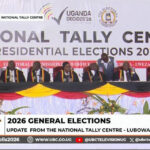
8:30pm: Museveni comes in and proceeds to greet all the other candidates. ARCHBISHOP Stanley Ntagali tells candidates to hold hands for prayers
8:17pm: Candidate keeps viewers and moderators waiting as they called out twice and he has not showed up
8:15PM: Candidates take to the stage for the debate
7:48pm: Guests get seated for the debate
7:28pm: Besigye addressing a press conference. He is accompanied by his wife Winnie Byanyima. Police scuffles with Besigye supporters who wanted to force themselves into the auditorium for the debate. However, the Police denied them entry.
6:59PM: Bessigye arrives but uses back door, proceeds to dress up before the debate starts
6:56PM: Museveni arrives for debate. Kizza Besigye yet to arrive
6:49PM: Kayla arrives.
Interviews on arrival
Gen. Biraaro: Rebel leader Joseph Kony is still in the jungles, we have the threat of terrorism and many other challenges. Therefore we need to pursue our national interests to relate with other countries, says Benon Biraaro.
It was good to go to Somalia and South Sudan, but we need a time frame so that we pull out our troops. We cannot take on the responsibility of building those countries, yet we have our tasks here.
Our international relations is based on military, not on what we sell or buy from there. If we retire President Museveni from politics, he can help us on those fronts.
Bwanika: Trade and investment will be key in my foreign policy. We need to build our competitiveness to attract more foreign direct investment. We have over 2,000,000 Ugandans in diaspora and they have been sending up to $1b back here and we need to support them in any way possible.
We are slow on fast-tracking political integration. Kenya and Tanzania are ahead of us in terms of development and we need to fast track. I want to majorly invest in trade between Uganda and South Sudan as well as DR Congo. I will build an international airport in Arua and a railway line linking to South SUDAN TO FACILITATE MORE TRADE.
We must be useful to Burundi and help to mitigate what is happening in the country. Uganda was given the opportunity to champion it, but we have not done much. I will do my role to encourage Burundi president to leave power. We have to balance between peace making and war mongering. I don’t think Uganda should have been in Congo. We shall restrict our troops from war mongering. On the question of where we deploy, it should be for peace missions.
Baryamureeba: If you have a neigbour like Sudan ad it is not secure, you have to look for a solution. It is important that we always work with our neigbours. When you go in as a country, it is very costly, therefore, involving neigbours is important. Those ate issues that should be resolved by Parliament.
Mbabazi: I believe in peaceful relations across the world, good neigbourhood, peace everywhere. We will have full accountability on foreign missions and we will be fully accountable to state institutions.
we should increase production so that we are able to generate sufficient income for our countries to reduce foreign debt.
Kyalya: Unless we come together as Africa, we shall not be able to develop. When I become president of Uganda, I will call back all soldiers who have been sold off. I have been told that each soldier is sold at $10,000 a month and he receives only $1400.
I will stop that. There are also women who are suffering tin the Arab world. We must have our children back home before we can have good relations with them. People are running out of the country because we have no minimum wage. In the first six weeks, we shall have a minimum wage.
It has taken them a long time, yet it took them a shirt time to pass a bad law that presidential candidates pay sh20m. we shall talk to our children and control terrorism rather than buying weapons to kill them. We should start production aimed at feeding ourselves so that we are not depending on our EU friends. We shall be a happy Uganda in a happy Africa.
We are being used by the other countries to fight wars.
6:21PM: Current Number of candidates
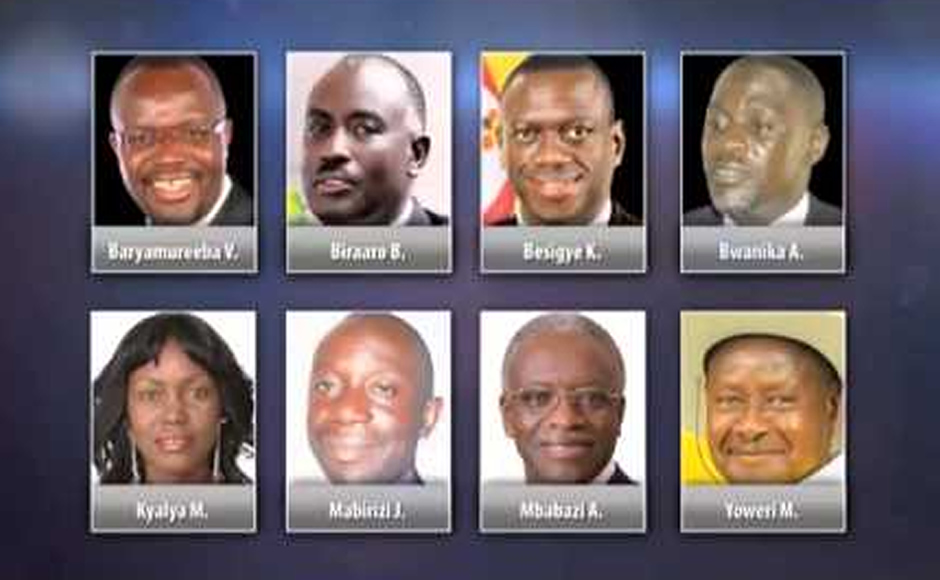
Four candidates have already arrived; Abed Bwanika, Benon Biraaro, Prof. Venansius Baryamureeba and Amama Mbabazi
Still to come is President Yoweri Museveni who is on his way from Kiyindi, Mukono and expected to be around Jinaj Road, Dr. Kizza Besigye, who is launching a song at Namboole Stadium. Maureen Kyalya and Joseph Mabirizi, although we are not sure where they are.
Nevertheless, the organisers are ready at the hotel waiting for the candidates.
5:51pm: Dr. Abed Bwanika arrives for the presidential debate at Serena. He proceeds to greet the memebers of the interreligious council and the elders forum.
5:52pm: Vicky Kingo, a member of Joseph Mabirizi’s taskforce arrives ahead of the presidential candidate Mabirizi
5:54pm: Justine Kasule Lumumba arrives at Serena clad in her yellow colours. Reports indicate that President Yoweri Musevei is on the way
5:00pm: Besigye is Kyebando, a kampala suburb, heading to Namboole Stadium. He is set to launch the Songa mbele song. The song has been used in the campaign throughout the country.
He is later expected at the Serena Conference Centre for the presidential debate, which starts at 7:00pm
Meanwhile, we bring you some of the profiles of today’s debate moderators
Who is Shaka Ssali?
Shaka, a Ugandan born American journalist, holds a doctorate in cross cultural communication and history from UCLA in California.
He is a former Ford Foundation Fellow and has received numerous honors, including a United Nations Peacekeeping Special Achievement Award in International Journalism.
Other awards include VOA’s Best Journalist Award and Kigezi College Butobere’s first ever Highest Achievement Award in International Human Communication. Butobere is located in Kabale, southwestern Uganda, and is Shaka’s alma mater.
During his career, Shaka has interviewed and hosted many presidents and prime ministers. Among them: General Olusegun Obasanjo, Former President, Nigeria; Levy Patrick Mwanawasa; Former President, Zambia; Tony Blair, Former Prime Minister, United Kingdom; Botswana President Seretse Khama Ian Khama; Ghana President John Evans Atta Mills; Tanzania President Jakaya Kikwete; Ellen Johnson Sirleaf, President, Liberia; Hifikepunye Pohamba, President, Namibia; Uganda President Yoweri Museveni; Joseph Kabila, President, DRC; Rwanda President Paul Kagame; and General Salva Kiir, First Vice President, and president of the government of Southern Sudan.
He has also hosted newsmakers and policy makers who interact with Africa, including: Norbert Mao, President, Uganda Democratic Party; Johnnie Carson, U.S. Assistant Secretary of State for African Affairs; Donald Yamamoto, Principal Deputy Assistant Secretary of State for African Affairs; Donald Kaberuka, President, African Development Bank; South African jazz legend Hugh Masekela; Nobel Peace Prize laureate Wangari Maathai; Luis Moreno-Ocampo, Chief Prosecutor, International Criminal Court; Mo Ibrahim, Chairman Mo Ibrahim Foundation; Nobel Literature laureate Wole Soyinka; Professor Muna Ndulo, Cornell Law School; Professor Ali Mazrui, SUNY; Professor George Ayittey, American University; Professor Sulayman Nyang, Howard University; Uganda Supreme Court Justice George Kanyeihamba; Dr. Rebecca Nyandeing de Mabior, a Southern Sudan government official and widow of former SPLA leader Dr. John Garang; Jeff Sharlet, author, The Family; Bob Hunter, Associate, Fellowship Foundation; Mbulelo Rakwena, former South African Ambassador to Brazil; Baffour Ankomah, Editor, NewAfrican magazine.

Who is Joel Serunkuma Kibazo?
He is Director, Communication and External Relations, African Development Bank (AfDB). He has a BA in Social Sciences; MA in International Business and Economic Development; MBA in International Business and Marketing. Public affairs and communications consultant.
Former: Journalist, Financial Times, reported on Africa’s business and financial sector; Presenter, programmes for BBC and other international broadcasters; Director, Communications and Public Affairs, and Spokesman, Commonwealth Secretariat.
Founder and CEO, JK Associates, a public affairs and communications consultancy offering specialized services in Africa. Member: CNN Africa Journalist of the Year Panel; Policy Committee, Centre for the Study of African Economies, St Anthony’s College, University of Oxford. Council Member, Royal Africa Society.
Museveni confirms attendance
The secretary general of the Inter-religious Council of Uganda Joshua Kitakule has confirmed that everything is set for the second round of the presidential debate.
Apart from president Museveni other presidential candidates attended the first debate but the organizers have told this website that all the eight candidates have confirmed attendance.
Meanwhile, the spokesperson of the NRM party campaign taskforce Mike Sebalu has confirmed that President Yoweri Museveni has found time on his busy schedule to attend the debate this evening.
The only female presidential candidate Maureen Kyalya told this website that she is ready for the debate and in case President Museveni appears, she wants him to explain his foreign policy.
Other candidates Dr. Kiiza Besigye, John Patrick Amama Mbabazi, Elton Joseph Mabirizi, Gen. Benon Bilaro, Dr. Abed Bwanika and Prof. Venacious Barymureeba also confirmed their attendance.
Second presidential debate takes shape
The Inter-Religious council of Uganda has finalised plans to hold the second Presidential Debate scheduled for Saturday this week at 7:00pm.
The first debate that was held on the 15th January was only attended by 7 candidates except president Museveni who said that he was busy campaigning in Western Uganda.
The debate will centre on foreign policy, international relations, international trade, security, cross boarder relations among others.
The chairman of the Organizing Committee, Justice James Ogoola, says that they have received confirmation of attendance from all the seven Candidates but hoping that the NRM sorts all the necessary adjustments for president Museveni to be able to attend.
Justice Ogoola adds that Voice of America’s Journalist Dr. Shaka Ssali and the Makerere University Head of the Political science Depart Dr. Suzie Muwanga, and Dr. Joel Kibazo will moderate the debate which will run for five hours.